I got a library card and have been trying to read before bed to quell my cold self (fighting at times with my impulse to watch a law and order internet episode). I just read Gertrude Stein’s Writings 1932 – 1946, a nice intellectual ramble after the over the top sexy apocalyptic sci fi of Gary shteyngart’s super sad true love story. There is one passage that I need to transcribe here before I return the book to the library:
 ‘one must not forget that the earth seen from an airplane is more splendid than the earth seen from an automobile. The automobile is the end of progress on the earth, it goes quicker but essentially the landscapes seen from an automobile are the same as the landscapes seen from a carriage, a train, a wagon, or in walking. But the earth seen from an airplane is something else. So the 20th century is not the same as the 19th century and it is very interesting knowing that Picasso has never seen the earth from an airplane that being of the 20th century he inevitably knew that the earth is not the same as the 19th century, he knew it, he made it, inevitably he made it different, and what he made is a thing that now all the world can see. When I was in America, I for the first time traveled pretty much all the time in an airplane and when I looked at the earth, I saw all the lines of cubism made at a time when not any painter had ever gone up in an airplane. I saw there, on the earth, the mingling lines of Picasso, coming and going, developing and destroying themselves…I knew that a creator is contemporary and as the 20th century is a century which sees the earth as no one has ever seen it, the earth has a splendor that it has never had, and as everything destroys itself in the 20th century and nothing continues, so then the 20th century has a splendor which is its own and Picasso is of this century, he has that strange quality of an earth that one has never seen and of things destroyed as they have never been destroyed.’
 (Gertrude Stein, p. 532 – 533)

so I’ve been getting apocalyptic vibes lately, from everything. i loved so much how gertrude writes of artists’ existing and responding to their time and also the unknown that is the future, and how even though Picasso never saw the earth from high above, his work almost predicted the way it might look. And I also loved her comparison of the way the ground looks from an airplane to drawing. It reminded me of this very stupid critique I had with
dennis oppenheim when he came to Wesleyan. I guess I say it was very stupid because he seemed so listless and dispassionate when he spoke about his own work, discouraging to me that the art world could take someone who’s early work was very ‘70s earth-worky conceptual, and churn them out into someone so clearly apathetic about art. But anyway, during his crit with me (about my abstract commercial pattern
unmakings), all he really said was that my work reminded him of the topographical quilt that is the earth seen from the window of an airplane. And like the seams running through my pieces, roads bisect farms, lines mingle and ‘[
come and go, develop and destroy themselves…]’ (stein).

it was also stein’s hinting at the fact that different eras destroy the ones that came before them, that really struck me, I guess I’ve thought about that before but never dared admit it. Just with all the contingency I think everyone feels right now but may not always acknowledge, I want to grasp this thing that is so remarkable to me, that things get destroyed, and leave a trace, and there’s just this push and pull as time passes. and for me, I derive comfort from inventing and engaging in processes of making and knowing and gathering, comfort in clothing, clothing that is a cocoon that could work to protect me from the harshness of the world. I think this is something I’m trying to get at for my portland show (I’m doing a show next month at
Appendix project space), finding this place where time, everyday ritual, and interaction with materials can be in dialogue with what goes on outside my studio, where things are confusing and there is hardship and destroying and rebuilding, constantly. There is fragility and beauty, but there is also utility, convertibility, mappings, systems, some sort of master plan.
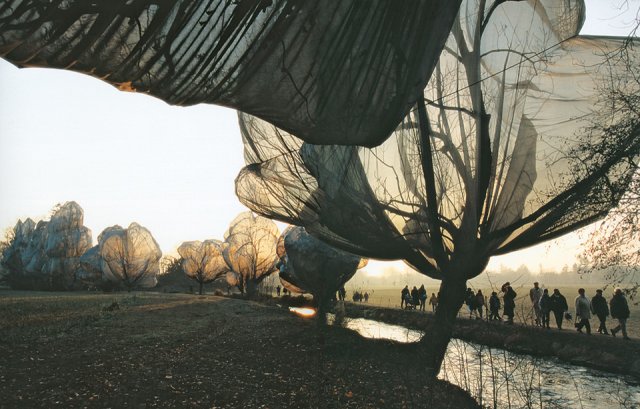
{photos, from top to bottom: glynis chaffin-tinglof's native, google image search for 'aerial view from airplane window', my own unmakings, and a photo swiped from this blog.}