issey miyake:


ernesto neto:


{neto installation @ pompidou centre (2004) ; celula nave (2009)}


Addressing a body of sculptural work like a fashion collection. Making like 50 ‘looks’ but questionable as to their function, not necessarily wearable clothes, but conceived as members of a closet. These looks have multiple thematic ideas running through them. Possible themes to be present running through the 'collection':
a. Sheerness (over or under materials), panty hose, beige, like skin, printed commercial patterns (from fwm) onto sheer fabric


{comme des garcons fw 09 from this blog, ernesto neto's while nothing happens 2008}
b. Maps and commercial patterns – paper
{my own pattern combine 2010, map (unknown source)}
c. Housing insulation, stuffed panty hose, suiting innards

d. Drawings indicating planning (or drawing textile design, ie polka dots), on maps, commercial patterns, fabrics—some printed at fwm


{leonardo da vinci studies of embryos circa like 1503, kiki smith lying with the wolf 2001}
e. Crusted over with glue, plaster, materials:


{plaster mask from style rookie's flikr, crusty old bodies from pompeii relics 'ghosts of vesuvius'}
f. Construction (ie. Mason line, florescent orange, traffic cones, treated as fabric/sewn/knit)


{construction site photo from a website curiously called 'erections,' christo and jeanne claude wrapped coast 1968-69}
g. Polka dots


{comme des garcons ss'10, light dots by julie lansom}
h. Old quilts

{gee's bend quilt (see more great ones here, bedroom by james merrell}
Ideas for 'Looks':
· Floor Piece: Sheer camping tent out of sewn flesh/hose colored tule, with tent poles. Panti hose coming off of it in places
· Voluminous sheer coat of same hose color, with housing insulation/suiting innards/interfacing in the front front/lapel, layer of construction nylon mason tape wrapping around that but beneath the tulle. pantihose for sleeves and skirt (sewn together in strips). Sheer tulle bloomers, crusted over with plaster.
· Long map/commercial pattern jacket and wide leg pants crusty with plaster, that buttons asymmetrically with nuts and bolts hardware. With small little sleeves. With commercial pattern front and big pattern pockets, Commercial pattern collar, insulation/interfacing/padding on collar. Drawings indicating planning (or drawing textile design, ie polka dots), on maps & commercial patterns surface. Worn with hose.
· Flat, cut out but unsewn commercial pattern tent jacket, sewed in place onto map. Tent-like structure but with pattern collar and nut and bolt buttons down the front. Little map pants. All crusty with plaster.
· Coat made out knitted fluorescent trail marking tape with pieces dangling. Buttons asymmetrically with nuts and bolts buttons. Half of the front is a commercial pattern jacket front. Pattern full collar and pockets, interfacing and padding. plaster crusted. Tied with little horse trail marking line.
· Coatlike Dress with snow fencing poof skirt and hood, traffic cones?, and bodice, sleeves, and collar made out of pieces of maps and commercial patterns. One side of the commercial pattern coat is longer than the other. Crusty with plaster. Worn with crusty polka dot leggings.
· Little tiny map/pattern jacket with collar and epaulets and nuts and bolts buttons. Big full skirt out of snow fencing and traffic cones. Little construction material leggings (snow fencing or knitting marking tape). All crusty with plaster. Little trail marking tape bow around collar.
· Façade of pattern front on top of snowfencing and traffic cone structure. Little crusty commercial pattern pants with polka dots drawn on them in charcoal.
· Long dress made out of maps and commercial patterns with pockets, collar, nuts/bolts buttons, with a long sheer hose colored dress over it. Housing insulation/padding is sewn between the layers. A pattern skirt protrudes from the front like an absess. Housing insulation and stuffed panti hose trail out of the bottom. Crusty with plaster.
· Wall piece: Maps are sewn into the places on an old quilt where it is coming apart. Brown (hose colored) sheer tulle is layered over about half of the surface, seamed in parts. There are parts where housing insulation is coming out, and parts where plaster is caked on. Panti hose coming off of the bottom, crusted and sad.
· Polka dot pattern coat (half overlayed onto polka dot fabric, half polka dots draw directly onto the paper, pattern pants with polka dots drawn on. A little trail marking tape belt tied through pattern belt loops. Hose.
· padded/wire/interfaced polka dot shirt façade with commercial pattern pockets and collar sewn onto Knitted nylon caution tape/snow fence skirt shape. All crusty with crusty nylon hose coming off of the bottom.
· Totem: 2 old quilts collaged together overlapping over housing insulation, and tulle/hose tube structure wrapped in one or two loops of fluorescent trail marking tape, tied dangling. Housing insulation comes out the bottom. Not crusty.
· Long flat map coat with places that are mostly flat, boxy, not sewn (like a kimono). Commercial pattern collar. Sleeves and front sides made out of quilt. Worn with hose. Crusty.
· housing insulation stuffed inside a nude tulle coat dress form (one sleeve is long, one is short). Tulle is overlayed over shoulder pads (polka dot patterned?) and commercial pattern lapel and collar. With nut bolt buttons, big industrial zipper down the side wear a heart would be. A little unzipped and housing insulation is coming out of the opening. Housing insulation and nylon coming out of the bottom. Excess tulle comes off of the form in places like a trail. Crusty.

 I've noticed a funny cycle that I go through as I go in and out of being inspired. sometimes i feel void of all inspiration and all i want to do is numbly look at fashion collections on style.com or in magazines, but then it backfires and i see something that really throws a wrench in my numbness and makes me so excited and angry at the same time because i wish that i made it so badly and i can't handle it. I was especially inspired this fall ‘10 by the ‘09 fall/winter’s comme des garcons collection. that is to say that i think it is one of the only things that i thought about for an entire 3 months. One thing kawakubo (the designer) did that inspired me to the point of wanting to copy were these ghostlike coats of flesh colored tulle, where all the seams were made visible by the sheerness of the fabric. Brought to my attention one of the reasons I love sheer fabrics so much, is because when the light shines through it’s the seams that really become the focus.
 I also love kawakubos sense of utility/fragility that screams survival in this collection—there's the sheer ghostly flesh colored tulle but then there's also military nods of army/navy type fabrics, even ethnic blankets, jacket facades, all collaged together, and I love how she uses what looks like twill tape (that you use to draw on dress forms normally) but she uses them to draw on her garments—completely brilliant! also there are toes painted on the oxfords...
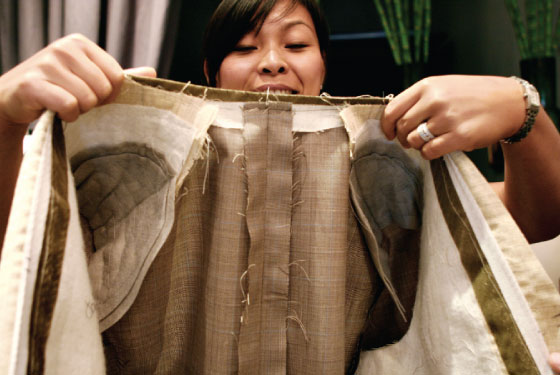
 When I was working at Berkeley rep, I learned from the tailor kathy that there are so many innards inside a men’s jacket, and I have been thinking for a while about making a coat where all these 'guts' (interfacing, padding, stitching, etc.) are visible. Or what if there were commercial patterns encased inside? I’ve always thought of the patterns/instructions as being just under the surface of clothes, as if you go back a step and they are revealed. I wonder if I could play with this idea, make the metaphor literal. There is something about sheer fabric covering things, like a haze, or veil, that really gets me; there is a little suggestion of time, or presence, without full disclosure.
 [etymological side note again--the word apocalypse comes from Calypso from the Odyssey (there is the Odyssey again, should I re-read?). Calypso is the nymph who hides Odysseus away for years, and the ‘calypse’ part of the word means to hide of cover, and apocalypse originally meant revealing, disclosing, uncovering, which I just am so excited by in the context of clothes, or knitting/unraveling, or getting dressed.]
 assembly that needs to happen, that they are so readily garments and also architecture. Plus there is something so astro turfy about camo. something very nature v. culture in a sneaky way that becomes uber deep. Through some handy internet research, I found these diagrams for set up, that are so incredible I keep thinking of replicating them in some way. I am scared of making 2 dimensional work again, but I think i would be able to if it was disguised as instructions. I will post
  pictures of the shelter ponchos once i finish sewing together the printed clothing that will emerge from the side, but today i just finished this pixelated camo screen
  printed siamese tankini (that wont be the title don't worry.) i plan to epoxy it so it will be more like a stiff body shell, so i have to make a mold for that. but you can see in the detail how i screen printed directions for its making directly on the fabric itself. the pixelated camo was really exciting to me, especially when i found out that it is harder to detect a person wearing it than regular camo, like on cameras the pixels hide the wearer better. another bonus about the epoxy that i learned from my prototype is that it will actually tone down the brightness of the camo and the screen printing i did just sings out, louder than pictured here. hawt.


