Wednesday, October 12, 2011
videos/imagery to make for amending :
walls breaking open / tearing down walls
fire, burning, unburning : the veil from the store?
light flickering on and off
cracks and gaps
commercial patterns ?
a needle floating back and forth
repetition in the fabric store -- buttons, thread, ribbons, stackings
Invitation:
Any wall — literal or metaphorical — blocks us from seeing. But we’re always finding those closed borders in each other and in ourselves. What does it look like when a wall is built, broken, and rebuilt? Through projection and sculptural installation, artists Silvie Deutsch and Kira Akerman clothe two brick walls in an empty lot on Oretha Castle with intricate textile structures to reveal the energy of their making.
Amending
Silvie Deutsch & Kira Akerman
October 22, 23 & 24, 8 pm to 10 pm.
Melpomene and Magazine
New Orleans, LA
Monday, October 10, 2011
To a Friend Going Blind
Today, because I couldn’t find the shortcut through,
I had to walk this town’s entire inner
perimeter to find
where the medieval walls break open
in an eighteenth century
arch. The yellow valley flickered on and off
through cracks and the gaps
for guns. Bruna is teaching me
to cut a pattern.
Saturdays we buy the cloth.
She takes it in her hands
like a good idea, feeling
for texture, grain, the built-in
limits. It’s only as an afterthought she asks
and do you think it’s beautiful?
Her measuring tapes hang down, corn-blond and endless,
from her neck.
When I look at her
I think Rapunzel,
how one could climb that measuring,
that love. But I was saying,
I wandered all along the street that hugs the walls,
a needle floating
on its cloth. Once
I shut my eyes and felt my way
along the stone. Outside
is the cashcrop, sunflowers, as far as one can see. Listen,
the wind rattles in them,
a loose worship
seeking an object,
an interruption. Sara,
the walls are beautiful. They block the view.
And it feels rich to be
inside their grasp.
When Bruna finishes her dress
it is the shape of what has come
to rescue her. She puts it on.
Monday, August 15, 2011
there's a show im trying to get work into , the theme is 'proof'...i was thinking about mathematical proofs: the act of demonstrating that something 'works', showing your steps... i started another easy stitch this time using 2 base fit patterns for 60s dresses. i guess they are the kind that depending on the build of your body, certain seams tell you they can be let out or taken in. there are funny diagrams that come with the patterns, and they are a lot less nice about body descriptions then we are now. taking this theme as an assignment, i cut chunks out of the patterns with the envelopes unopened. i then am following the patterns, backed with sheer fabric, and combining the dresses into one (as each one only provides half a dress.) the result is deformed and weird, and i am still trying to figure out how i want to display the directions. the rules for the submission state the piece has to be 'ready to install' when you submit it (you submit the actual piece, not a photograph), so i have to think about making something that isn't too complicated to install... and perhaps in this way the directions for making are as much part of the piece as their result; especially as i proove my steps. try to make it clear what i did, maybe i mark things really dark in charcoal... prompted by a conversation with maddie about her work, i've been thinking about what it means to use 'found materials' and how much an artist should or shouldn't manipulate materials... when something makes the transition from trash to spectacle. with clothing patterns (or maps), the material itself is already potent without any manipulation. then by giving these materials a new form, i can take the existing meanings and layer them with others.
Friday, July 29, 2011
commercial pattern abstract forms with wire seams
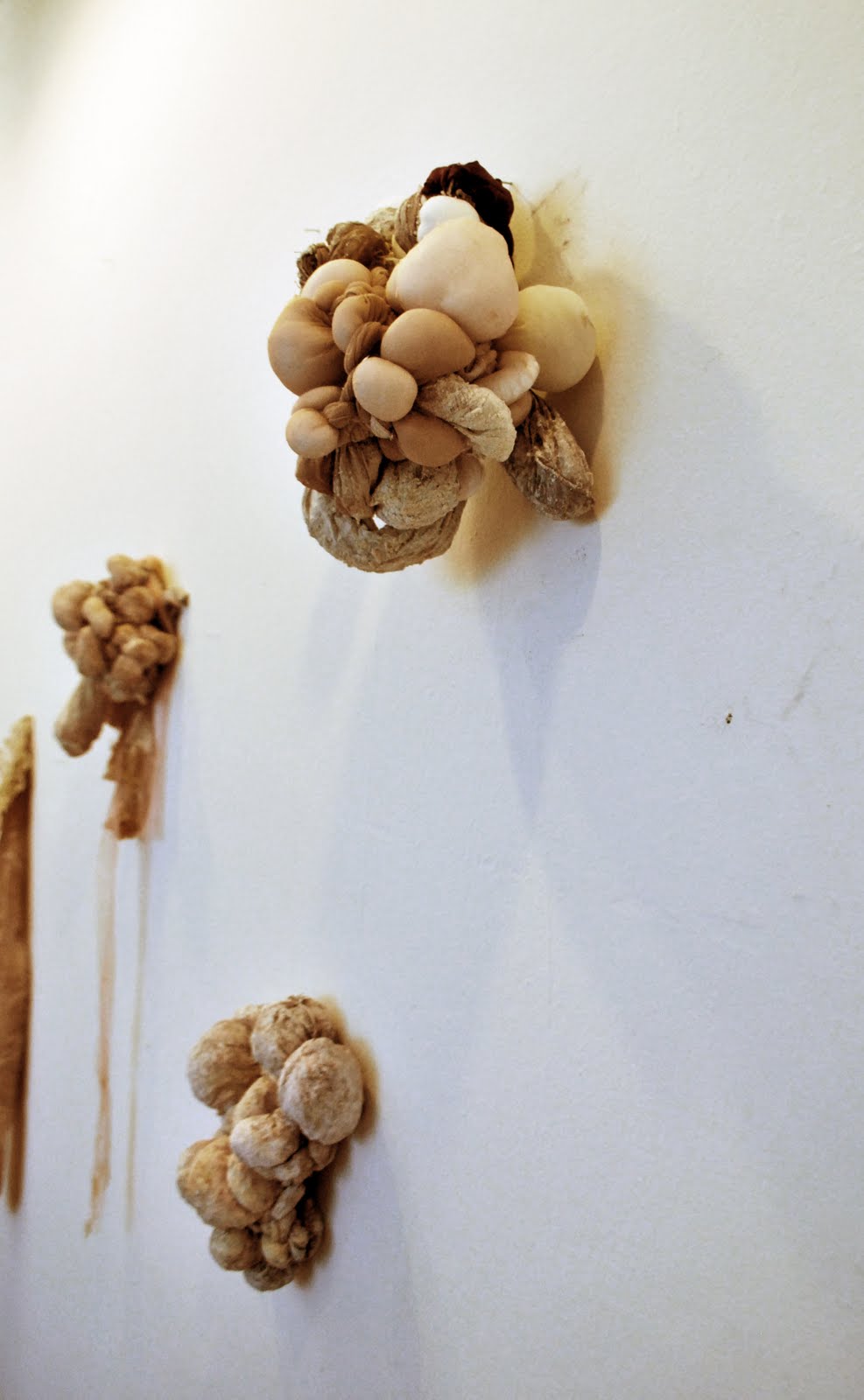
'bulb forms' (not a title, just what i've been calling them)
pantihose, straw, batting, tinsel, plaster, rubber cement, elmers, tulle, doilie
still figuring out the next step for these 'bulbs'. they differ from my other more systematic work because they are more concerned with layered processes and the act of making than creating rule systems. i still feel unclear about these pieces; i found myself saving pantihose, probably for a year now, because i knew they were interesting to me. i wanted to cut them so they were flat and stretch them over things, but i started stuffing them and knitting them up with very big knitting needles, and it all started happening very organically. i had an idea to embed them into the wall ala henrique oliveira-- they are textile-based things, coated in construction materials; its then that what they are made of becomes abstracted and closer to both body/skin bubble-ups, and also could be some sort of weird growth in a plaster wall. sort of goes with what i was thinking about with projecting knitting stop-motion movement onto walls to make the wall appear to crawl or have its own weird agenda. i was also thinking they could be embedded into garments and become more literal body explosions, but they do suggest the body already without garment present.
as for the wire pieces-- the wire travels along the seam lines of the forms. i want to try making some out of maps, using the highways as a system for where the wire 'seams' should go.
in my last post i was reading the eva hesse book from my post 1945 art history class in college, and i really liked how she talked about art being a way for people to make use or reel in the chaos around them. that art is where people (both artists and viewers) funnel their desire FOR chaos, and its the artist's job to figure out how they want to sculpt or hide or order that chaos. its the chaos that helps the artist (and the viewer) feel alive when they are participating in the work. this really touched me: i use maps and patterns and knitting as systems, almost mathematical or rule-based as source material, yet i work in mostly a whim-like way. i use the system driven materials to give some semblance of order, yet my making process can be very chaotic. so the map sculptures: i was thinking about maps as objects. they are made to point you to something-- a house, a treasure, a post office, a city, a country, a field. often the thing they point to is unknown, foreign, undiscovered to the person looking. what lost place to i want to point to in using maps? i like the idea of suggesting something to point to, even if it is just a hunch.
Sunday, April 10, 2011
Not to brag, but today was spent sitting in the sun in my garden in my bikini, drinking tangerine juice and drawing. In the absence of having a studio I've been drawing and planning things I want to make. this is the thing i'm most excited about so far:
Addressing a body of sculptural work like a fashion collection. Making like 50 ‘looks’ but questionable as to their function, not necessarily wearable clothes, but conceived as members of a closet. These looks have multiple thematic ideas running through them. Possible themes to be present running through the 'collection':
a. Sheerness (over or under materials), panty hose, beige, like skin, printed commercial patterns (from fwm) onto sheer fabric
{comme des garcons fw 09 from this blog, ernesto neto's while nothing happens 2008}
b. Maps and commercial patterns – paper
{my own pattern combine 2010, map (unknown source)}
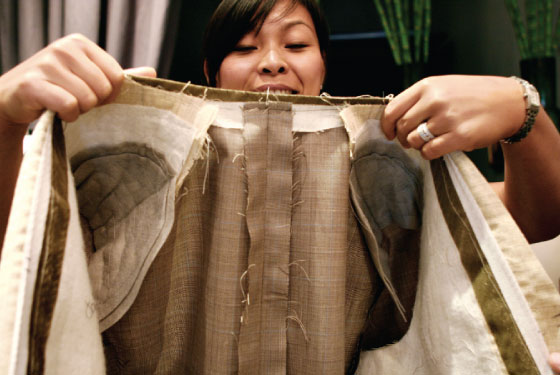
c. Housing insulation, stuffed panty hose, suiting innards
{housing insulation, suit innards from fun article in the new york times fashion mag about suits}
d. Drawings indicating planning (or drawing textile design, ie polka dots), on maps, commercial patterns, fabrics—some printed at fwm
{leonardo da vinci studies of embryos circa like 1503, kiki smith lying with the wolf 2001}
e. Crusted over with glue, plaster, materials:
{plaster mask from style rookie's flikr, crusty old bodies from pompeii relics 'ghosts of vesuvius'}
f. Construction (ie. Mason line, florescent orange, traffic cones, treated as fabric/sewn/knit)
{construction site photo from a website curiously called 'erections,' christo and jeanne claude wrapped coast 1968-69}
g. Polka dots
{comme des garcons ss'10, light dots by julie lansom}
h. Old quilts
{gee's bend quilt (see more great ones here, bedroom by james merrell}
Ideas for 'Looks':
· Floor Piece: Sheer camping tent out of sewn flesh/hose colored tule, with tent poles. Panti hose coming off of it in places
· Voluminous sheer coat of same hose color, with housing insulation/suiting innards/interfacing in the front front/lapel, layer of construction nylon mason tape wrapping around that but beneath the tulle. pantihose for sleeves and skirt (sewn together in strips). Sheer tulle bloomers, crusted over with plaster.
· Long map/commercial pattern jacket and wide leg pants crusty with plaster, that buttons asymmetrically with nuts and bolts hardware. With small little sleeves. With commercial pattern front and big pattern pockets, Commercial pattern collar, insulation/interfacing/padding on collar. Drawings indicating planning (or drawing textile design, ie polka dots), on maps & commercial patterns surface. Worn with hose.
· Flat, cut out but unsewn commercial pattern tent jacket, sewed in place onto map. Tent-like structure but with pattern collar and nut and bolt buttons down the front. Little map pants. All crusty with plaster.
· Coat made out knitted fluorescent trail marking tape with pieces dangling. Buttons asymmetrically with nuts and bolts buttons. Half of the front is a commercial pattern jacket front. Pattern full collar and pockets, interfacing and padding. plaster crusted. Tied with little horse trail marking line.
· Coatlike Dress with snow fencing poof skirt and hood, traffic cones?, and bodice, sleeves, and collar made out of pieces of maps and commercial patterns. One side of the commercial pattern coat is longer than the other. Crusty with plaster. Worn with crusty polka dot leggings.
· Little tiny map/pattern jacket with collar and epaulets and nuts and bolts buttons. Big full skirt out of snow fencing and traffic cones. Little construction material leggings (snow fencing or knitting marking tape). All crusty with plaster. Little trail marking tape bow around collar.
· Façade of pattern front on top of snowfencing and traffic cone structure. Little crusty commercial pattern pants with polka dots drawn on them in charcoal.
· Long dress made out of maps and commercial patterns with pockets, collar, nuts/bolts buttons, with a long sheer hose colored dress over it. Housing insulation/padding is sewn between the layers. A pattern skirt protrudes from the front like an absess. Housing insulation and stuffed panti hose trail out of the bottom. Crusty with plaster.
· Wall piece: Maps are sewn into the places on an old quilt where it is coming apart. Brown (hose colored) sheer tulle is layered over about half of the surface, seamed in parts. There are parts where housing insulation is coming out, and parts where plaster is caked on. Panti hose coming off of the bottom, crusted and sad.
· Polka dot pattern coat (half overlayed onto polka dot fabric, half polka dots draw directly onto the paper, pattern pants with polka dots drawn on. A little trail marking tape belt tied through pattern belt loops. Hose.
· padded/wire/interfaced polka dot shirt façade with commercial pattern pockets and collar sewn onto Knitted nylon caution tape/snow fence skirt shape. All crusty with crusty nylon hose coming off of the bottom.
· Totem: 2 old quilts collaged together overlapping over housing insulation, and tulle/hose tube structure wrapped in one or two loops of fluorescent trail marking tape, tied dangling. Housing insulation comes out the bottom. Not crusty.
· Long flat map coat with places that are mostly flat, boxy, not sewn (like a kimono). Commercial pattern collar. Sleeves and front sides made out of quilt. Worn with hose. Crusty.
· housing insulation stuffed inside a nude tulle coat dress form (one sleeve is long, one is short). Tulle is overlayed over shoulder pads (polka dot patterned?) and commercial pattern lapel and collar. With nut bolt buttons, big industrial zipper down the side wear a heart would be. A little unzipped and housing insulation is coming out of the opening. Housing insulation and nylon coming out of the bottom. Excess tulle comes off of the form in places like a trail. Crusty.
Thursday, January 20, 2011

time in india as if it were more legitimate than the actual indian lady's experiences. it was silly and funny to be the prop in such a hissy fit. but anyway, because i'm not very nice, i never gave the sari to the new age lady. as i printed on it at the workshop with permanent black ink, and then as i cut the thing to pieces, i thought sorry, in my head to this lady. sorry, sari.Thursday, January 13, 2011
I got a library card and have been trying to read before bed to quell my cold self (fighting at times with my impulse to watch a law and order internet episode). I just read Gertrude Stein’s Writings 1932 – 1946, a nice intellectual ramble after the over the top sexy apocalyptic sci fi of Gary shteyngart’s super sad true love story. There is one passage that I need to transcribe here before I return the book to the library:
‘one must not forget that the earth seen from an airplane is more splendid than the earth seen from an automobile. The automobile is the end of progress on the earth, it goes quicker but essentially the landscapes seen from an automobile are the same as the landscapes seen from a carriage, a train, a wagon, or in walking. But the earth seen from an airplane is something else. So the 20th century is not the same as the 19th century and it is very interesting knowing that Picasso has never seen the earth from an airplane that being of the 20th century he inevitably knew that the earth is not the same as the 19th century, he knew it, he made it, inevitably he made it different, and what he made is a thing that now all the world can see. When I was in America, I for the first time traveled pretty much all the time in an airplane and when I looked at the earth, I saw all the lines of cubism made at a time when not any painter had ever gone up in an airplane. I saw there, on the earth, the mingling lines of Picasso, coming and going, developing and destroying themselves…I knew that a creator is contemporary and as the 20th century is a century which sees the earth as no one has ever seen it, the earth has a splendor that it has never had, and as everything destroys itself in the 20th century and nothing continues, so then the 20th century has a splendor which is its own and Picasso is of this century, he has that strange quality of an earth that one has never seen and of things destroyed as they have never been destroyed.’ (Gertrude Stein, p. 532 – 533)
so I’ve been getting apocalyptic vibes lately, from everything. i loved so much how gertrude writes of artists’ existing and responding to their time and also the unknown that is the future, and how even though Picasso never saw the earth from high above, his work almost predicted the way it might look. And I also loved her comparison of the way the ground looks from an airplane to drawing. It reminded me of this very stupid critique I had with dennis oppenheim when he came to Wesleyan. I guess I say it was very stupid because he seemed so listless and dispassionate when he spoke about his own work, discouraging to me that the art world could take someone who’s early work was very ‘70s earth-worky conceptual, and churn them out into someone so clearly apathetic about art. But anyway, during his crit with me (about my abstract commercial pattern unmakings), all he really said was that my work reminded him of the topographical quilt that is the earth seen from the window of an airplane. And like the seams running through my pieces, roads bisect farms, lines mingle and ‘[come and go, develop and destroy themselves…]’ (stein).